
What Came to Mind by Alex Robb
I was looking for happiness in all the wrong places, like the here and now.
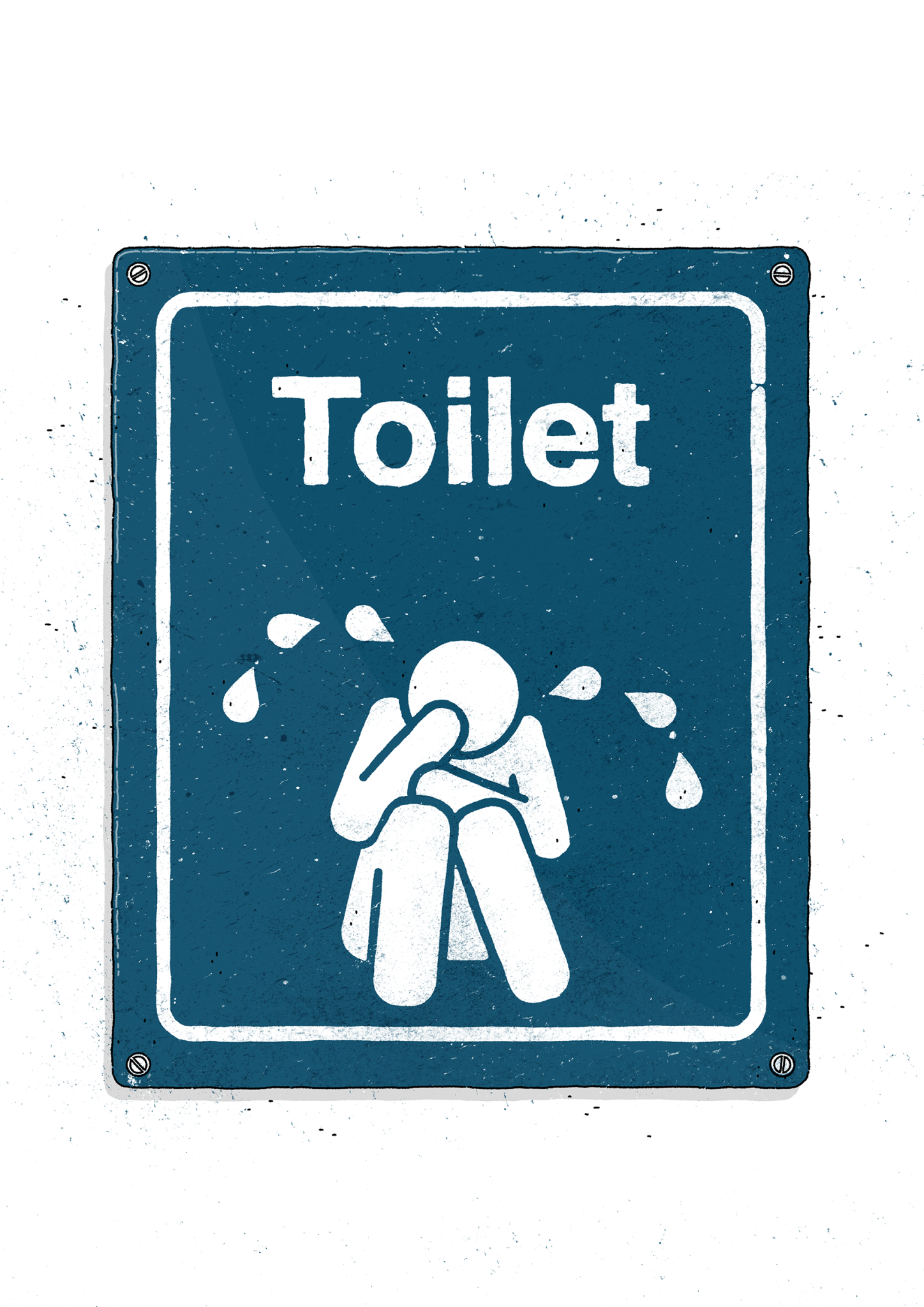
Illustration by David Galletly
I was looking for happiness in all the wrong places, like the here and now.
I realised this while I was walking to the loos on the office’s second floor. People were sitting at their desks and looking at their laptops the way you might look at someone on a first date, and this only made me feel worse inside.
No one was in the loo when I walked in, and I thanked all the gods that might or might not exist. I wanted to kiss their big, looming faces and have their beards hang over me like vast landscapes of cloud. Then I cried in a cubicle.
The cubicle did funny things to the sound of my crying. It gave it a kind of echoing quality, which made it sound almost distant, like I was listening to a voicemail of someone crying. Someone who cried with such conviction that it made a kind of crackling noise on the voicemail, like human vinyl hiss or whatever.
This only made me cry harder for some reason. I’m not a hundred percent sure why. Maybe for the same reason a baby cries when they hear another baby crying, but I don’t really know about all that.
It’s a good thing I was sitting on the loo, because I nearly shat myself when I heard the toilet flush in the cubicle next to me. I couldn’t tell you how long someone had been there, or how they managed to sneak into the room without me knowing.
Hey, a voice said. It wasn’t a voice I recognised.
I didn’t say anything at first. I thought if I was silent for long enough maybe they’d think the crying was some kind of auditory hallucination or whatever. Their guilty conscience or something.
Hey, the voice said again. Are you alright?
All good, I said. Don’t worry about me.
No?
Nah. All good on my end.
There was a moment of silence. Then the voice said, I dunno, mate. You don’t sound too good.
The voice was coming from the stall next door. I looked at the thin partition separating us, and I felt a bit like I was in a confession booth, assuming they still have those around.
Well, I said, maybe not too good. But it’s alright. I’ll be alright.
How do you know?
What?
The voice repeated itself: How do you know?
Another silence. I looked at the locked cubicle door. It was funny how you could tell you were in an office loo just from the fact it was so pristine. No messages had been written or sprayed onto it. Nothing had been etched there with a penknife. It was no pub loo. No stall covered in scrawled odes to all those things that inspire yearning and despair in men, like football and politics and the names of women. Even their own elusive names.
The noise I made was something like: Hmm.
Is that you saying you don’t know?
I guess. But you always end up being alright in the end, don’t you? Alright enough, I mean.
Not always.
No?
Nope, the voice said. Not always.
It seemed a heavy thing to say, and I felt its heaviness enter the room like a cat plopping itself down on your lap with a sudden need for love.
Well, I said, maybe not then, I guess.
So, the voice said. What’s up?
It’s funny how you can hear a question like that a hundred times a day, but then you can also go years without anyone saying it just like this. Without anyone really actually wanting to know.
I didn’t say anything, so there was another silence.
Mate, the voice said. What’s up?
Another pause. Then I told him God’s honest truth.
I don’t know, I said. I just don’t really know, you know?
You don’t know why you’re crying in the office toilets?
No, I said. Not really, I guess.
Not even a little?
I don’t think so.
You can’t reflect a little and find one, or maybe even two or three factors that might have prompted all of this?
I thought about it. No, I said again.
Really?
Like, I can think about things in my life that aren’t – that aren’t optimal, you know? But I don’t know if they’re all that much connected with this. Whatever this is.
The crying, you mean?
If that’s what you want to call it.
It’s the word I know it by.
But anyway, I said, I’m not like all that certain they’re that connected, you know? Like in that cause and effect kind of way. Whatever’s suboptimal about my life and this, I mean.
Not at all?
Not really. It’s not like I was thinking about any of that stuff just now or whatever. I don’t think I was thinking much about anything to be honest with you.
You weren’t thinking about anything?
No, I said. I don’t think so.
Now there was silence on his end, and I wondered what he was doing in his stall. If he was like sitting down on the toilet lid or if he was just standing up or whatever.
You know, he said, I’m getting the impression you don’t want to talk about the so-called suboptimal stuff in your life. Is that right?
Yeah, I said. Probably.
So what are you gonna tell me then? He asked.
What?
Well you’re gonna have to tell me something.
Am I?
Well yeah. I can hardly walk out of here without knowing anything about you. Not after all this.
You can’t?
You really expect me to go back out there and just get on with my emails and spreadsheets after this whole palaver? After all I’ve gotten out of you is that in your entire life, in your whole entire life, is that not everything is absolutely optimal. Like what?
I hesitated.
Well, I said. What do you want to know?
I don’t know. Anything. Whatever comes to mind.
What comes to mind?
Yeah, the voice said. What comes to mind when I say, what comes to mind?
It surprised me how quickly a thought did come to mind when he said that.
I don’t know, I said. It’s not very relevant or all that exciting.
Go on.
Well, I don’t know why, but what came to mind was – was the first time I went to the football. Like as a kid and stuff.
That’s good, the voice said. Go on.
You sure?
Shoot.
Well, I started. Then I stopped.
Come on, mate. Spit it out.
Alright, I said. It’s just nothing out of the ordinary really happened, you know? Like it’s all pretty basic. But anyway, if you’re dying to know, I guess it started with us getting the train into Manchester. Just Dad and me, I mean. But I don’t remember that all too well, to be honest. What I do remember is the walk from the station to the stadium. We kept passing all these brown road signs pointing the way to SportCity, so I asked my Dad what that was, because I thought SportCity was literally a whole other city, you know? Not just like an area which had been built for the Commonwealth Games and whatever.
Yeah, the voice said.
So there was that, I said, and I also think it was the first time I ever saw the police. At least on such a large scale, you know? They were surrounding this pub we went past, and the police were like filming all these fans on camcorders, like were shooting home movies or something. Like they were recording footage for You’ve Been Framed. And I remember the police horses too! I remember thinking they were huge, like mutant horses or something, and I remember seeing their shit going all the way down the road to the stadium, just shit after shit after shit. That made me laugh. Even made Dad laugh too when I pointed it out.
Could you see the stadium by then?
Yeah, we could see it. We saw it on the train, actually, now that I think about it, so I guess I do remember part of the journey there. It’s crazy the first time you see a big stadium like that. I couldn’t imagine being sat inside it, you know? It looked like a fortress or something, just the size of it, how metallic it was and whatever. And then, like less than an hour later, we were sitting inside it, weren’t we? Dad and me: me eating the chips he got me, him flicking through the match day programme. I still have that somewhere. It had a picture of Shaun Wright-Phillips on the front. You remember him?
And the game? The voice asked. How was the game?
Not that great. We lost two-nil. It was to United as well. But I didn’t really care too much about that. I was already obsessed by then. It was the singing that started it off, I think. When we first headed out into the stands and there were all these men singing and chanting and stuff, and they were waving scarves over their heads and what have you. Obviously that’s all normal, I know that now, but I’d never seen anything like that as a kid, you know? I’d never seen men act that way.
No?
I shook my head, and I only realised afterwards that he couldn’t see me doing that.
And I was always asking Dad to take me to games after that. I’d ask him all the time, and he would take me pretty much whenever he could. It wasn’t super often, but he did his best. And it was funny going to games with him, because it was the first time I saw him as more than a dad. Like, it was the first time I realised he was just a guy, if you know what I mean? That he was just like everyone else there. And it’s a weird thing to feel when you first feel it. When you first realise your parents are just people. When you’re like seven or eight years old or whatever. Although I dunno if that makes sense.
Yes, the voice said. That makes sense.
But yeah, I said. That’s what came to mind anyway. Is that good enough for you?
Yep, the voice said. That’s good. But you should think about it some more. Just by yourself.
Think about it?
Yes, he said. You should think about why it was the first thing that came to mind.
Then I heard him unlock the door and head out of his cubicle. I could hear him washing his hands and using the hand dryer. I heard the main loo door open and close next, and after a few seconds of silence I knew he was gone. Gone just like that.
I didn’t know what to do. I didn’t want to head out straight away in case he was watching who came out of the loos. So I sat there a bit longer and wiped my face with toilet paper. I had no idea what I looked like, or how I sounded to the guy, but I tried not to think too hard about that. I just thought about going to the football with Dad. Thought about how much I missed that, and how much I missed him. And when I cried a little more it didn’t sound so far away – it sounded more like listening to my own heartbeat using a stethoscope or something.
Then I headed out of the loos and went straight back to my desk.
Alex Robb
Alex Robb is based in Glasgow and primarily writes short fiction. He is currently working on putting together his first collection of short stories dealing with post-industrial cities, representations of history, and the power and limits of conversation.