
Spectrums by Amber Heath
A joy in class. A mind like a sponge. A little shy. Not much of a talker. Few friends. Likes her comfort space, doesn’t like breaking out of routines. But an excellent student, very easy to deal with.
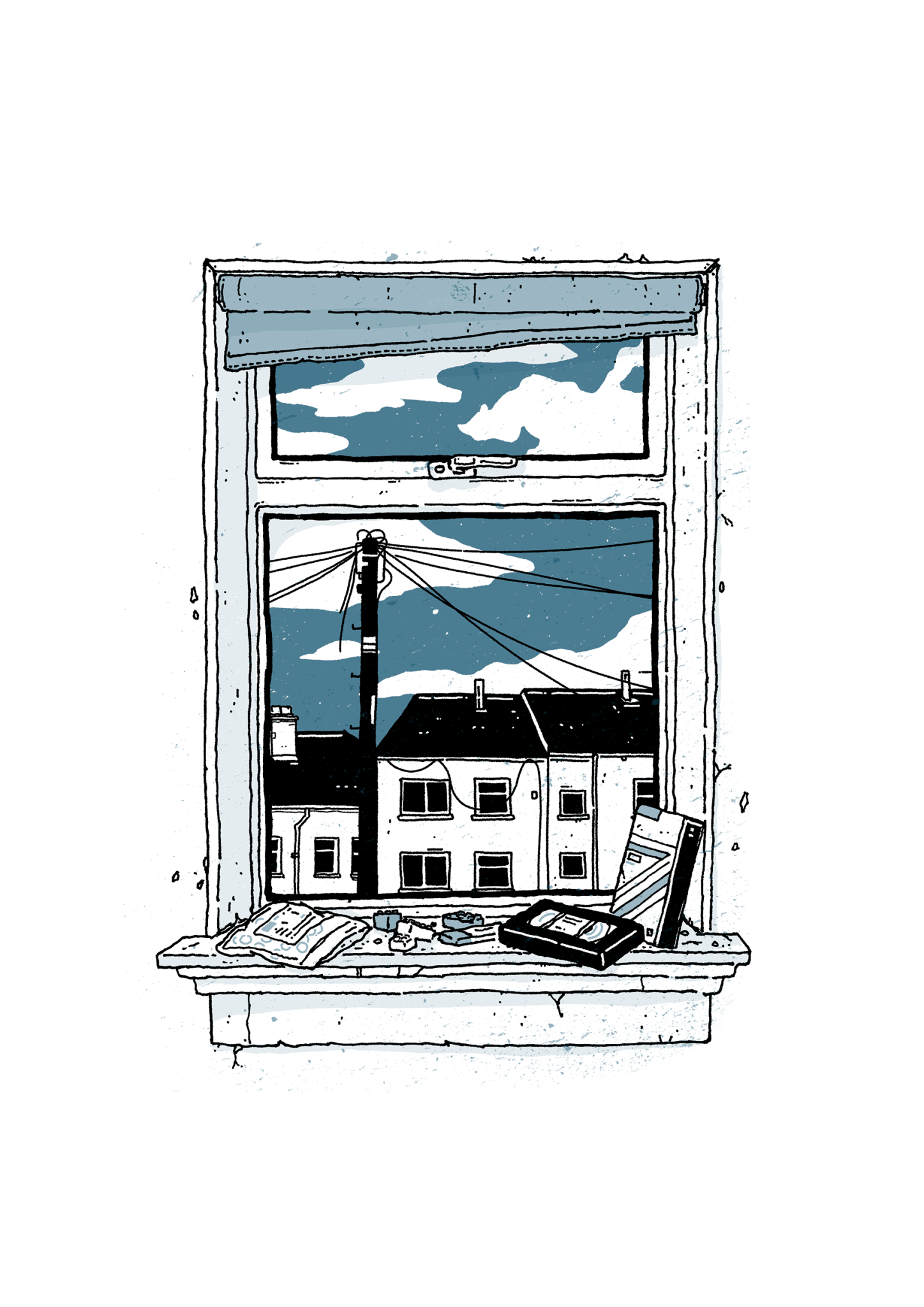
Illustration by David Galletly
The hospitals were never painted brightly. Councils don’t like bold colours for some reason. The walls are always an off-colour. Off-pink, off-blue, off-green. Off-white is popular. Perhaps they were all bright at some point, and it’s just the decades of wear and tear that make them off.
When I think of my earliest childhood, that’s what I see. Off-colour walls, harsh overhead lighting, lifts with lots of buttons for playing with. The smell of bacteria-killing cleaners, covering the scent of human decline.
We were always alone in those corridors. We couldn’t run around in the wards of course, we wouldn’t want to disturb anyone, especially at that time of night. But the corridors were alright. The staff had bigger things to worry about than two unaccompanied children. And it’s not like we were scared, or upset. We were quiet, self-occupied. We were used to being alone. Mum and Dad had bigger things to worry about than two unaccompanied children.
We watched each other. That’s why there were two of us in the first place. We’d spend all day outside, when not in the hospital. We would wander around overgrown gardens or play on the mown grassy field outside the council estate. The walls there were off-colours too, in much poorer nick. Large chips of paint picked away, revealing the colourless concrete beneath. We would climb up crumbling walls and onto forest green wheely bins. I climbed a telephone pole once. I remember seeing so far, all the way past the baked red bricks of the buildings and out towards a blue, blue sky.
We weren’t the only ones. There was a girl in the next flat over who had only one hand and one of those big Barbie hairdresser heads. I remember neon pink and artificial blonde over a scraped up smile. There was a boy from the estate who had a Gameboy Colour with a Pokémon Red cartridge and a scar across his forehead. There were teenagers, with skateboards and scooters and rollerblades in vibrant ‘90s patterns, that would sometimes let us try them. Dad point blank refused to buy us any of those things.
There were other grownups too. The old woman in the flat across the close from us was wonderful. She’d give us yellow boiled sweets if we sat and listened to her talk. The lady up the stairs had a wee black sausage dog that would knock me over in excitement, trying to lick my face. There was a very young girl with a very young son who would give us deep purple flavoured drinks when we played with him. Dad sat us down once and very sternly told us not to accept things from others and not to bother her so often, but we didn’t listen, and it’s not like he could stop us anyway.
Dad was always the one who told us not to do things, or said no to things we wanted. Mum was more vague. About everything. She’d always say ‘maybe’. Sometimes she was less responsive. A hum. A nod. Sometimes she wouldn’t respond at all, no matter how I called for her. I’d tell her the house was on fire to get an answer. It didn’t always work. When she looked at me, with her milky blue eyes, I was never certain she was using them to actually see me.
We called it ‘going spacey’. We never got a better explanation than that. It meant that sometimes Mum would start talking oddly. Like she couldn’t open or close her mouth properly. She couldn’t speak very well. She couldn’t understand what you were asking for. She wouldn’t remember what you said. It was like she was wrapped in a blurry mist that she had to struggle through to reach the real world outside. She couldn’t do much of anything, beyond lying in bed. She spent a lot of time in bed, among beige bedsheets that got darker and grimier over time.
We always knew that when Mum went spacey it meant we needed to go away and leave her alone. Mum was ill. Mum was spacey. And it meant that we couldn’t expect too much of her, not like the other Mums. If Mum was late picking us up that was because Mum was spacey. If Mum couldn’t do fun things for us it was because Mum was ill. If Mum didn’t take us to school it was because Mum was in bed, and it wasn’t far anyway, we could do it ourselves. We didn’t need her. We could do anything together.
But there were two years between my brother and I, and two years is a yawning chasm when you’re a child.
So I’d go to school alone, in a dirty blue cardigan, a stained white polo, and a crumpled black skirt. And I was great at it. I learned to read while still in nursery. I liked the contrast of bold black text on clean white pages. It was as natural as breathing to me, and it made everything else so much easier too.
The teachers loved me for it. A joy in class. A mind like a sponge. A little shy. Not much of a talker. Few friends. Likes her comfort space, doesn’t like breaking out of routines. But an excellent student, very easy to deal with.
My brother wasn’t great. He struggled with words more, couldn’t make them focus. The teachers didn’t like that, and said it was his fault. He preferred physical things, like building spaceships out of multicoloured Lego blocks. He could complete puzzles faster and win games better than I could. But those things weren’t quiet, weren’t easy, didn’t get him the praise I got. He would get into more fights in the playground. He was harder.
He was sent to the hospital by a couple of boys once when I was six. The school told Mum and Dad he slipped on an orange peel. There was no one to take me home, so they gave me printer paper and a neon pink highlighter, and sat me outside the headteachers office alone. I tried writing out all the numbers I knew to see how far I could get before someone came for me. I got to one hundred million. The walls of the school were off-colour as well. It seeps into everything in the real world.
There was nothing off about the colours on the TV. Presented in Brilliant Technicolour, a marvel of technological innovation. My brother used to build castles out of our mountain of VHS tape boxes. I could recite my favourite shows word for word. The characters were smart, and funny, and they had lots of friends they could rely on. Illness was a plot device, easily dismissed or fixed by the end of the film. Things would be sad for a time, but eventually it would end just as brightly as it had begun.
Mum didn’t care what we watched. If she had an opinion she never told us. Dad didn’t like our films, but he never disparaged them. He never told us we were wrong about our likes and dislikes. He listened to our opinions seriously.
But he preferred police procedurals. Poirot, Midsummer Murders, A Touch of Frost, Inspector Morse. Dour men in suits looking very serious while talking about gruesome events. Women lying on floors with fake orangey blood covering them. Palettes of bleak blues, granite greys, muddy greens, cloudy skies.
Dad didn’t believe in lying to children. If I had a question it got answered. About animals. About war. About medicine. About how babies were made. About the colour of the sky. About trains. About violence. About yellow warning signs.
Dad said ignorance was dangerous. If we were ignorant children, we might pick up his cigarettes, so he told us why cigarettes were bad. If we didn’t know what his pills did, we might try to take them, so he told us what they were, and why they were dangerous.
Dad didn’t believe in sheltering children either. We were both intelligent, and if something was too much for us, we could always leave, he said. We didn’t. We watched a lot of things together. Science fiction. Horror. True crime. War documentaries. Christmas shows. The news. Disaster films. Monster movies. Thrillers. Swearing and sex and drugs and rock n roll. My world was shaped entirely by what my father liked – and by Walt Disney.
We watched The Time Machine when I was eight. He pointed out to the skill it took to create the time lapse of the sun moving across the changing sky, and the dresses on the mannequins getting shorter. Another form of animation. He explained the cultural context of the bomb shelters and air raid sirens, how they adapted the book to reflect the then-modern fear of nuclear devastation. The metaphor of the degenerate but clever Morlocks in their real, earthy tones, and the pure, innocent but fatally stupid Elois in their pastels and with their books made of dust.
My Dad’s eyes changed colours like the sky in that film, quickly but vividly. Sometimes they were blue and clear like mine. Sometimes they were a nutty brown like my brother’s. A lot of the time they were a grey-green of his own. They were always dark. Often glassy. But for all my father’s faults, I never had to lie to get him to look at me.
We couldn’t explain what was wrong with Mum, but with Dad it was simple. Everything was wrong.
He couldn’t breathe properly. His heart was weak. His legs didn’t work. His back was bent. His blood sugar was unstable. Diabetic neuropathy. Osteoporosis. Cardiomyopathy. Chronic obstructive pulmonary disease. The end result of 40 years of hard living. We knew exactly what was wrong and what the consequences were. Next to his chair he had a bag of chalky white pills he took every single day.
He couldn’t leave the house alone, so we always had to be with him. Sometimes he couldn’t leave the house at all, in bed with Mum, so we had to go out for them. Food shopping, picking up prescriptions, depositing money at the bank. Making tea, changing light bulbs, cleaning up. We called them errands. Kids run errands all the time, right? It’s not like anyone else could do them.
Doctors, nurses, teachers, shop assistants, pharmacists … they were busy. They had jobs to do. More important and urgent things to mind. And we were fine. There was nothing wrong with us. A child as smart as that one didn’t need any checking up on. And boys will be boys, they get into trouble all the time.
We weren’t upset, we weren’t acting any differently to how we’d always acted. We weren’t black and blue. If anything we were better than those louder, angrier children they had to deal with. The ones that bled red, that shouted blue, the black sheep of society that grew up with us in those council coloured estates and schools and hospitals.
We were different. We were wonderful. Polite and well-tempered. We knew how to act. How to be present and helpful, or absent and quiet. We smiled, we did our work, we followed instruction. We were so mature for our age.
No one needs to care about an off-colour child.
Amber Heath
Amber Heath was born in Paisley before moving to Blairgowrie, Perthshire aged eight. She moved to Edinburgh at seventeen to study English and Film, and hasn’t left since. She was diagnosed as an adult with autism by the NHS and aspires to someday have an NHS ADHD diagnosis as well.