Learning from Decolonial Approaches to Oral History and Psycho-Emotional Health
A short learning symposium looking especially at creative and decolonial approaches to oral history work in communities, and some of the ethical and methodological challenges of oral history interviews for recording refugee histories. For anyone interested or working in decoloniality; oral history; community and public archiving; intangible cultural heritage; psycho-emotional health and ‘wellbeing’.
This learning event will focus on the sharing of experience and practice, set within the context of the Art of Family Life exhibition at Listen Gallery in Glasgow. This is a small community space so numbers will be limited. The symposium is intended to be informal and intimate, with opportunity for exchange and moving around. Introduced and moderated by Soizig Carey, Art of Family Life Project Officer at the Mental Health Foundation.
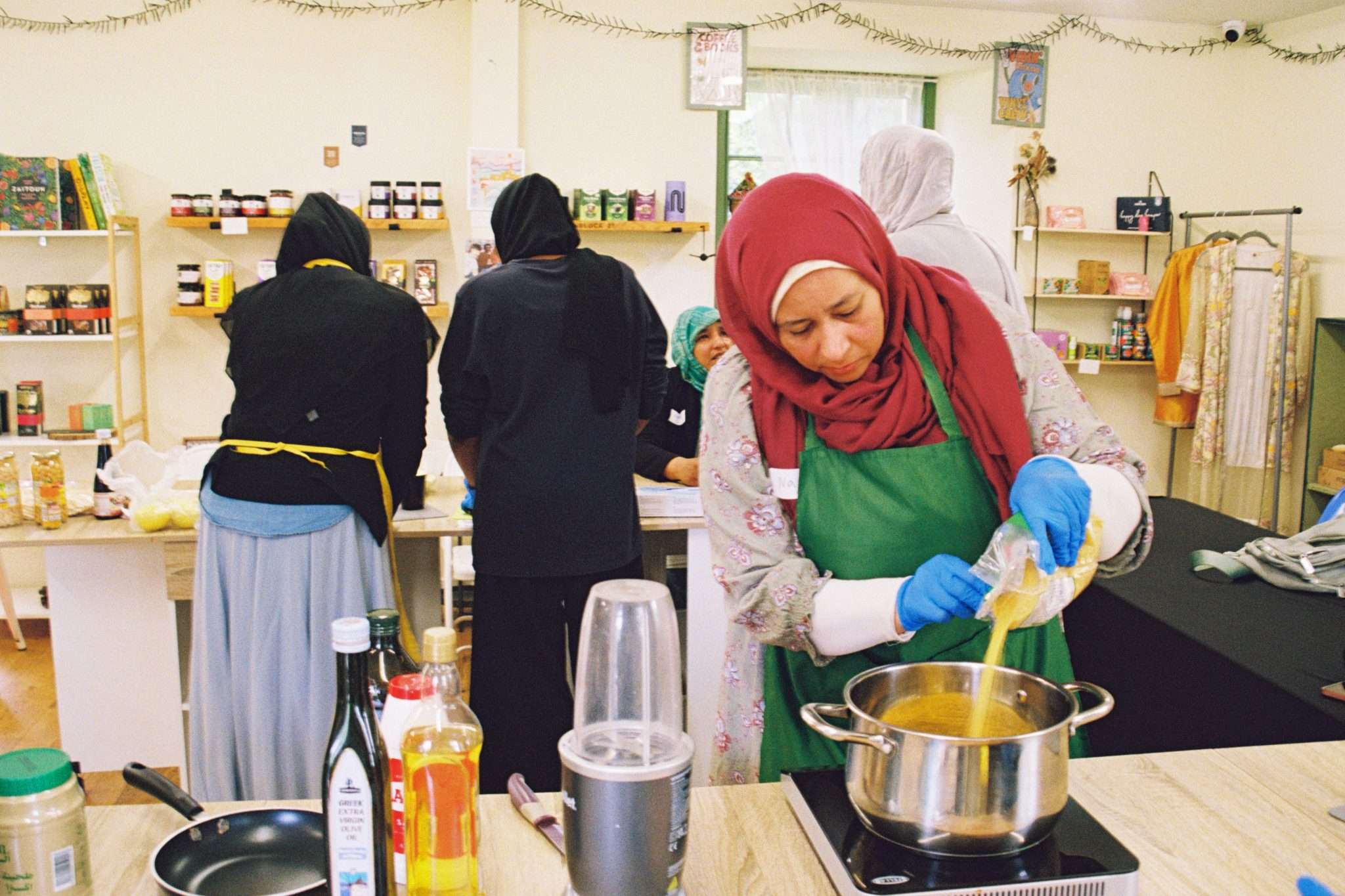
Through oral history and community gathering, the Art of Family Life reflects the creativity, joys and struggles of intergenerational refugee communities who have settled in Glasgow. This sensitive exhibition and events programme has been developed by community members with the Mental Health Foundation over a two-year period across Glasgow, exploring the importance of intangible cultural heritage, belonging, listening and perspectives of wellbeing. Working with the Scottish Oral History Centre, volunteer community members have collected diverse oral histories in over six languages. Local socially engaged artists Luna Issa, Mia Gubbay and Riah Naief co-created sessions exploring memory, identity and connection through cooking, poetry and song-making.
These meetings began by using creative methods as a means of communicating inherited cultural knowledge with each other, but they also became “family away from family”, where family was understood as a space of care, not only blood relationships.
Presented in partnership with Listen Gallery and the Scottish Oral History Centre at the University of Strathclyde.
Supported by Gathering Ground, Soundplay Projects and the National Lottery Heritage Fund.
About the Contributors
Riah Naief
Riah Naief is a sound artist and runs Listen Gallery, a sound arts gallery and communal listening space in Glasgow. The theory and practice of listening is at the root of their practice. They believe that listening is a revolutionary act, a way to shape and change behaviours and society.
As part of the Art of Family Life creative programme, Riah collaborated with Nawal, Hanadee, Ameena, Shaimaa, Esra, Amira and Zahara using vocal play, call-and-response, and song-making, exploring where language is held in the body and why it matters to share it through sound. The Listening through Tongues workshops invited the group to collectively enter the body through listening and then move outward into sounding together, creating a collaborative space for creative exchange.
Riah will share some of these listening and sounding practices, discuss the importance of not recording everything, and what worked and what didn’t work in collaboration.
You can listen to Listening through Tongues as part of the Art of Family Life exhibition or at a special listening event prior to the symposium. The group created three sound works created collaboratively exploring language and voice, with a focus on the throat as an instrument and the tongue as an extension of memory, identity, and connection.
Leyla Neyzi
Leyla Neyzi is an oral historian and social anthropologist. She lectures in History at University of Glasgow. Educated in the US, she has over twenty years of research and teaching experience in Turkey. She has worked with pastoral nomadic communities, individuals and communities whose memories and histories have been written out of official history (Kurds, Christians, Jews, Arabs, immigrants, refugees).
Leyla was forced to leave Turkey in 2019 due to signing the Academics for Peace petition. She will discuss an ongoing AHRC project, Archives of Solidarity based at SOAS, University of London. For this project, the research team worked with refugees, citizens, youth and activists in border regions of the UK and Turkey. The research included oral history interviews as well as workshops on zine-making, body mapping, creative writing, ethnography, audio and video creation and oral history.
Erin Jessee
Erin Jessee is a Lord Kelvin Adam Smith Research Fellow in Armed Conflict and Trauma (Modern History) at the University of Glasgow, and a Research Associate with the Scottish Oral History Centre in Glasgow. She is an oral historian and genocide scholar who works primarily on post-genocide Rwanda. Her research interests include mass atrocities, transitional justice, symbolic violence, mass grave exhumations, and the ethical and methodological challenges surrounding fieldwork amid highly politicised research settings.
Erin will discuss both the value and limits of oral history, and deep listening as essential, especially amidst traumatic narratives.
Mia Gubbay
Mia Gubbay is a heritage consultant, curator and artist with a background in community co-production, oral history and decolonial practice. Her work involves the careful holding of historical and present experiences of migration, drastic change and the collective re-imagining of place. She collaborates with artists and uses creative social history methodologies and transformative approaches to conflict, healing and repair shaped with the people she is working with.
As part of the Art of Family Life creative programme, Mia collaborated with Nina, Fifi, Amina, Forough, Ghanima, Fakhriya, Farhat and S to explore experiences, memories and histories through dialogical poetry. This space on a Monday morning became “family away from family”, where family was understood as a space of care, not only blood relationships.” Resulting in the beautiful new publication, Questioning Calm Within our Monday Morning Family, now available as a limited edition.
Mia will share her journey of adapting and co-developing oral history methodologies with collaborators from communities which have and are experiencing historical and present forms of oppression and exclusion within the cultural heritage sector.
Katherine MacKinnon
Katherine MacKinnon is a public historian, arts worker, writer and researcher based in Glasgow. She works with groups of people to explore and document experiences of everyday life, past and present. Her PhD at the University of Glasgow looks at ways of documenting, understanding and communicating refugee histories of Scotland from the 1970s to the present day. With Radical Glasgow Tours Katherine researches, designs and leads radical history walks around Glasgow.
Katherine will draw on her experience using collaborative creative methods – including poetry and creative writing, collage, shared reading and translation – to explore alternative ways of recording and understanding everyday life.
These practices have resulted in poetry collections, visual records of collaborative work and ethnographic notes, which as well as forming a collection of primary source material in their own right, have also served as memory prompts for follow-on oral history interviews.

The Art of Family Life
The Art of Family Life is presented in partnership with Listen Gallery and the Scottish Oral History Centre. Installation is supported by Soundplay Projects and the project is funded by the National Lottery Heritage Fund.
The exhibition runs every day from 2pm–7pm until Wednesday 18 November, excluding Thursday 12 November when it will be closed for ticketed events only.