
The Anatomy of a Mother by Rachel Munnoch
My body no longer feels inhabited. It feels occupied. You wanted this, I remind myself. I did. I still do.
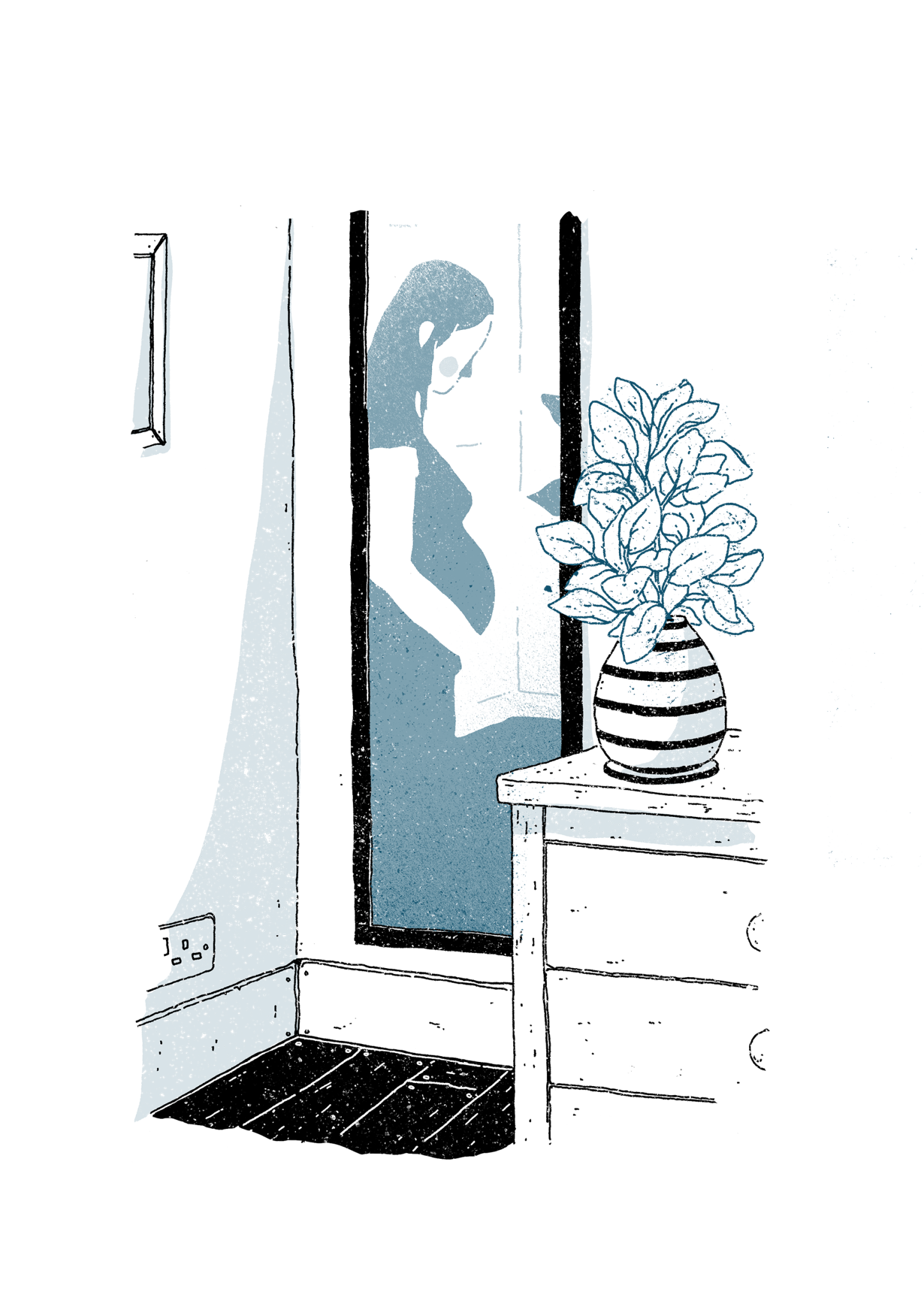
Illustration by David Galletly
It’s been thirty-eight weeks, and I barely recognise myself in the mirror.
I turn sideways and stare at the silhouette with a mixture of horror and disbelief. My stomach juts so far from my body it feels grafted on—an enormous swollen sac dragging the rest of me behind it like an afterthought. My spine bows backward to compensate, vertebrae grinding beneath the strain.
And that’s just for starters.
My hips click when I walk. My knees crack audibly beneath the shifting burden of all this new weight. Some mornings I wake convinced my skeleton rearranged itself in the night.
The pain is neverending.
“Lumbar lordosis,” the doctor informs me. “All perfectly normal.”
Perfectly normal.
Isn’t it comforting to know the sensation of your body slowly warping itself out of shape is medically sanctioned?
“You’re positively glowing!” they say.
Glowing. There are several words I’d use to describe my current state. Glowing is not one of them.
Swollen? Definitely.
“It’s because of the blood,” the doctor explains matter-of-factly.
And there’s so much blood now—thirty to fifty percent more than before. Enough to sustain the little life growing inside me. Enough that I can feel it pulsing through my extremities: heavy, wet, relentless. My veins rise beneath my skin in dark branching cords. Heat radiates from me ceaselessly. My fingers puff around my wedding ring. My feet have spread wider at the ends of my legs, softer and alien-looking.
The baby moves constantly now.
Slow turns. Deliberate shifts. An elbow presses outward hard enough to deform my stomach completely, stretching the skin into impossible shapes. I watch with horror-struck fascination as sharp little fingernails drag themselves along the inner wall of my abdomen, as though trying to claw its way out.
My body no longer feels inhabited.
It feels occupied.
You wanted this, I remind myself.
I did. I still do.
Then why do I feel trapped inside my own skin?
Sometimes I imagine my stomach splitting open.
Not dramatically. Not all at once. Just a tiny tear at first near my navel, like overstressed fabric. Then another. Thin seams unzipping under pressure while blood and viscera spill out down my swollen legs.
I try to shake the thought away, but it always returns, circling back like unclaimed luggage on a conveyor belt. Rituals are the only thing that prevent this terrible thought from becoming a reality—my only remaining illusion of control.
I wash every grocery item in scalding, soapy water before putting it away. I scratch circles into the palm of my hand because if I stop halfway through, something terrible will happen.
Rinse and repeat. Rinse and repeat.
Great. I’ve lost control of my mind as well as my body.
Is that perfectly normal too?
“Aren’t you excited?” they ask.
“Of course,” I lie.
Sleep becomes impossible. I exist in fragments between exhaustion and panic. My body no longer beats to natural rhythms. Every organ inside me has been displaced, compressed, and repurposed for someone else’s survival.
And all the while, I can’t breathe.
I wake in the middle of the night gasping for air because there isn’t enough room inside of me to breathe anymore. My uterus has swollen to the size of a watermelon, forcing my diaphragm upward so my lungs can never fully expand. Every breath feels stolen through clenched ribs. Acid burns the back of my throat because my stomach has been compressed into the wrong shape. Food sits inside me for hours like rotting matter. My abdominal muscles separate down the middle to make room for growth, leaving my core weak and distorted.
Growth.
Such an innocent word for something so invasive.
The rituals worsen.
I count every step before climbing them. Wash my hands until the skin cracks across my knuckles. Check the locks six times before bed because odd numbers feel unsafe.
Unsafe means vulnerable.
Vulnerable means something terrible could happen to the baby.
Or because of the baby.
The thoughts arrive uninvited.
What if she’s dead in there?
What if she isn’t?
My body and mind have become strangers to me. I no longer recognise the thing I’ve become.
When the birth finally comes, the relief is short-lived.
People speak about labour as though triumph waits on the other side of it. A crescendo. A release. But when it finally happens—when my body is torn open to let her through—I feel only absence.
One moment she is inside me. A part of me. Consuming me.
The next, she isn’t.
And I am left behind.
They place her on my chest while doctors stitch parts of me back together beneath a bloodstained sheet. My husband cries. Everyone smiles. Congratulates me as though I’ve crossed some holy threshold into womanhood instead of surviving a controlled catastrophe.
“She’s beautiful,” he whispers.
She is.
That makes it worse.
I want to love her without fear. I want to hold her without imagining all the ways a body can break. I want to sleep without jolting awake to make sure she’s still breathing.
But my brain no longer understands how to stop searching for danger. Even after the pregnancy is over, my body and mind behave as though it still belongs to something else.
“OCD, PTSD and PPD,” the doctor informed me a few weeks after the birth. “It’s very common.”
That doesn’t stop me from feeling like a failure.
Five years later, I am mostly in control of my mind, if not my bladder.
She is thriving. I am improving.
The skin on my stomach hangs loose and unfamiliar, mapped with white stretch marks that look less like scars than fractures. My hips remain wider. My feet larger. My wedding ring no longer fits over the swollen ridge of my knuckle. When I cough or laugh too hard, something deep in my pelvis aches with a quiet mechanical wrongness, as though the architecture of me shifted permanently during the process and never settled back into place.
Funny how nobody warns you creation can feel this traumatic. Even traumatic feels too clinical for what happened to me—too neat, too survivable-sounding. Pregnancy hollowed me out and remade me simultaneously, body and mind reshaped around an absence that still echoes years later.
“Healing takes time,” they assure me.
But healing implies restoration.
“That’s just called being a mother,” they say in an accusatory tone.
As though becoming and losing are not sometimes the same thing.
We speak of motherhood almost exclusively in terms of creation, though so much of it feels like erosion. A slow shedding of one self to make room for another.
A metamorphosis.
It’s been five years, and I am still changing.
Rachel Munnoch
Rachel Munnoch is an award-winning, Glasgow-based writer whose work has featured on television, streaming services and print publications both nationally and internationally. Her professional interests include screenwriting, speculative fiction, experiential non-fiction and media production.